


(Looking forward to presenting at the Barrie Sandbox Centre on 15 June for their Defence and Dual Use 101 day. See you there.)
EXECUTIVE SUMMARY
The period was dominated by high level diplomacy with Beijing, and the outcomes seemed modest relative to the optics. The Trump-Xi summit (14-15 May), the first US presidential visit to China since 2017, produced an order for 200 Boeing aircraft, USD 17 billion a year in agricultural purchases, and clearance for Nvidia H200 sales, but no joint communique, no, and no significant movement on Taiwan. Days later Putin arrived in Beijing (19-20 May) for his 25th visit, timed to the 25th anniversary of the China-Russia friendship treaty: a red-carpet welcome, more than 40 agreements signed, a joint statement condemning “irresponsible” US foreign policy and the Golden Dome missile shield, and repeated language about a “multi-polar world order.”
The Shangri-La dialogue was held in Singapore this year, concurrent to CANSEC. At Shangrila the Singaporeans and 16 other countries announced a partnership on sub-surface infrastructure protection. Canada was conspicuously absent from the list of partners. Chinese Foreign Minister Wang Yi’s visit (28-30 May) was the first by a Chinese foreign minister since 2016. He met PM Carney and Minister Anand to advance the updated strategic partnership and suggested Canadian exports to China could double, beyond Ottawa’s own target of a 50 per cent increase by 2030. Nearly concurrently, the HMCS Charlottetown transited the Taiwan Strait days before Wang landed. Engagement should not mean losing the bubble on Chinese coercion and strategic aims. Is there something to learn from Singapore, where interest-based negotiation with Beijing and the US is treated as normal statecraft rather than a loyalty test?
SUMMARY OF WHAT TO WATCH
Immediate (Next 30 Days)
CPSP strategic partner selection. A preferred partner is due before the CUSMA review opens 1 July. Anticipate final surprises; both bidders were still adding industrial commitments into the last week.
Medium-Term (2026)
Can Canada thread the interest-based needle with China and the US at the same time? The export-doubling talk will be tested by the next inevitable coercion incident.
GCAP progress. London has moved on funding. Does Ottawa make a push toward the programme, or watch from the fence?
The Indo-Pacific General at Large. LGen Macaulay’s mandate, resourcing and reporting lines. Impressive that Canada has appointed a LGen to represent the CDS in the Indo-Pacific. Can we make the most of it?
Strategic (2026+)
Korea’s nuclear submarine ambitions. Does Jangbogo-N change the upgrade path for the KSS-III Canada would be buying into, and is there a Canadian connection (Westinghouse’s civil nuclear work, AtkinsRéalis) waiting to be made?
The AirAsia order and the A220’s industrial footprint in Asia. Where do regional support and sustainment land, which Canadian suppliers ride the programme, and does CAE’s regional training footprint expand on the back of it?
AUKUS Pillar 1 strain. Australia will now take only second-hand boats. If the US, UK and Australia struggle with Pillar 1, do they take their eye off the ball on Pillar 2? And why don’t Japan, Korea, Canada or others organize their own advanced-capability cooperation?
CANADA: Biggest CANSEC Ever, AirAsia’s Mirabel Win, RIMPAC Commitment, CPSP End of the Beginning
CANSEC 2026 (27-28 May): the biggest yet. Roughly 20,000 registrants against 15,000 last year, with some 60 international delegations and close to 600 VIPs. Submarine diplomacy ran through the show (see CPSP below).
AirAsia orders 150 A220-300s (6 May). The largest single firm order in the A220 programme, announced with the PM on hand at Mirabel, pushing the type past 1,000 firm orders. AirAsia becomes launch customer for the 160-seat configuration, with deliveries from 2028 and a list value around USD 19 billion. The A220 is the former Bombardier C Series, making this a Quebec aerospace win rather than a Bombardier sale. Separately, Airbus Helicopters signalled it is eyeing Canada as a production centre for global export.
RIMPAC 2026 commitment (announced 30 May). HMCS Regina and HMCS Ottawa, a CP-140 and roughly 800 personnel to the 30th RIMPAC, which expects more than 25,000 participants. Regina fires the Evolved Sea Sparrow Block II; Ottawa gives the Underwater Warfare Suite Upgrade its first real-world test
A General in the Indo-Pacific Representing the CDS . LGen Derek Macaulay, until January the deputy commander of UN Command in Korea, is now serving as a representative of the Chief of the Defence Staff with an Indo-Pacific focus with the title: Chief of the Defence Staff’s Senior Military Representative, Indo-Pacific.
CPSP: end of the beginning. A preferred partner is due before the CUSMA review opens 1 July; both bids are assessed as meeting the RCN requirement, with contract signature expected around 2028 and first delivery no later than 2035. Hanwha doubled down, adding more depth to the relationship with Algoma Steel(1 June, announced at an Ontario auto plant): up to CAD 345 million in facility development and steel procurement, including CAD 275 million toward a structural beam mill in Sault Ste. Marie, all contingent on winning, on top of a partner web that now runs to many many Canadian firms. Germany countered in person. Pistorius pitched four Type 212CD boats by 2036 at CANSEC, with Berlin and Oslo each releasing a slot from their own order books, framed as entry into a 24-boat NATO fleet, and TKMS signed a teaming agreement with CAE (29 May) covering training, simulation and long-term sustainment, its first heavyweight Canadian industrial anchor, and Germany has agreed to buy a substantial amount of Canadian LNG.
Watch: Results of the Senate and House reviews. Final surprises in the CPSP bids. What mandate does the Canadian Indo-Pacific General get? How does the AirAsia order change the regional industrial and sustainment footprint?
SINGAPORE: Shangri-La and Tiger Balm, the Odd Man Out Underwater, Cap Vista Open for Business
Shangri-La Dialogue (29-31 May) and a busy month of defence diplomacy. Singapore hosted the 23rd dialogue with 44 countries and 54 ministerial-level delegates. Canada was represented by CDS Gen. Carignan, and Canadian and Indian defence officials met on the margins to advance the Defence Dialogue launched in March. Earlier in the month the SAF and US Army completed Exercise Tiger Balm which I’m including solely for the name. (4-15 May), the 45th edition of the longest-running bilateral exercise between the two armies, held this year at Joint Base Lewis-McChord and Yakima Training Center in Washington State, covering multi-domain operations and a C-IED live fire.
Underwater security and the odd man out. Singapore and 16 other countries used the dialogue to launch an effort to protect critical underwater infrastructure. Canada was not among them, a conspicuous absence given Canadian engagement on subsea infrastructure security elsewhere. At the same forum, the AUKUS partners announced their first Pillar II “signature project”: payloads and enabling systems for uncrewed undersea vehicles, with first capabilities targeted for 2027. A closed trilateral deliverable, announced at a multilateral forum.
Cap Vista Accelerator has five challenges open. DSTA’s strategic investment arm currently has five thematic solicitations open to global firms, running from an open innovation call to cyber resilience, multi-modal AI and counter-UAS. Leading-edge requirements with programme money behind them, and an opportunity to serve a customer that demands gold-standard solutions.
Watch: Was Canada’s exclusion from the undersea group intentional or incidental? And, as with NATO DIANA, will Canadian firms end up disproportionately represented in Cap Vista challenges?
JAPAN: Flexing Export Muscle Amid Domestic Protests, Mogami Momentum, GCAP Funding
Emerging public trepidation with the more muscular posture. Members of the public rallied in Tokyo on Constitution Memorial Day (3 May) against the Takaichi government’s moves to revise Article 9 and expand the military, with further rallies through the month and coordinated events reported in roughly 150 locations. The industrial ledger reads differently: Mitsubishi Heavy expects a profit surge as the export rules ease.
Mogami class: the order book builds. Indonesia has now confirmed receiving offers of Mogami frigates and submarines from Japan. New Zealand opened frigate-replacement discussions with Australia and the UK (7 May), with the upgraded Mogami and Britain’s Type 31 the named candidates, and Tokyo publicly welcomed Wellington’s interest. The defence ministers of Japan, Australia and New Zealand then met trilaterally on the margins of Shangri-La, their first such setting, with Mogami export talks on the agenda. The Australian programme anchors it all: eleven frigates, the first three built in Japan, first delivery December 2029.
GCAP: London moves money. The UK is pushing a GBP 6 billion funding package to keep the 2035 sixth-generation timeline on track, after months of reported Japanese frustration over British budget uncertainty. For Tokyo, 2035 is a hard deadline tied to F-2 replacement, and the programme is the test of Japan’s shift from security consumer to co-developer.
Watch: GCAP progress. Are we going to make a push or not? Mogami outcomes in Wellington and Jakarta.
SOUTH KOREA: Pressure on CPSP with a Ministerial and a Submarine Visit, Nuclear Ambitions Unveiled
Seoul sails the floor model to the customer. ROKS Dosan Ahn Changho, accompanied by ROKS Daejeon, arrived at CFB Esquimalt (23 May to 2 June): the first trans-Pacific deployment by a ROK Navy submarine, a 14,000 km transit, weeks before the CPSP decision.
Minister Kim Jeong-kwan in Ottawa (5-6 May). South Korea’s Minister of Trade, Industry and Energy met Minister Joly among others, reportedly highlighting industrial synergies between the two countries’ firms, pushing collaboration on future technologies such as hydrogen, and requesting active Canadian government support for incoming Korean investment.
Blocks sale to Ukraine. Seoul continues to deny Kyiv the KM-SAM II air defence system, citing its policy against exports into active conflicts, even as it advances sales of the same interceptor to Middle Eastern buyers, with Qatar and Kuwait reportedly next in line.
Nuclear submarine plan unveiled (26 May). As Korea pushes conventional boats to Canada, it is looking at nuclear options at home. The Ministry of National Defense released the Basic Plan for a domestically built nuclear-powered submarine, the Jangbogo-N project: low-enriched uranium fuel, design and construction in Korea, first boat launched in the mid-2030s and commissioned in the late 2030s, with non-proliferation commitments worked through Washington and the IAEA.
New industrial tie-ups. LIG Defense & Aerospace, Magellan Aerospace and Hanwha Ocean signed an MOU under CPSP focused on Canada-based capabilities in underwater weapon systems and lifecycle support, including a phased path to in-country assembly of munitions and unmanned systems. On the battery side, Canada’s NEO Battery Materials announced a defence partnership with the ROK Army’s Capital Defense Command (6 May) for drone and robotics batteries, following a live demonstration at the CDC parade ground on 30 April. Hanwha Ocean also signed an MOU with Quebec rocket firm Reaction Dynamics.
Watch: The nuclear submarine future. Does Jangbogo-N change the upgrade path for KSS-III, and what are the long-term fleet plans? How will Westinghouse or AtkinsRéalis feature, if at all?
AUSTRALIA: Joint Live-Fire with the RCN, Canadian Jets Onboarded, AUKUS Buys Used
Bombardier supplying jets for Australian maritime surveillance (26 May). Bombardier Defense will provide three Global 6500s to US contractor Metrea, which will fly maritime surveillance missions for the Australian Border Force under an effects-as-a-service model.
AUKUS: Australia accepts used boats. Canberra confirmed (31 May) it will receive only second-hand or in service Virginia-class submarines from the US rather than new builds, a major switch absorbed in the name of schedule. Deal with the devil?
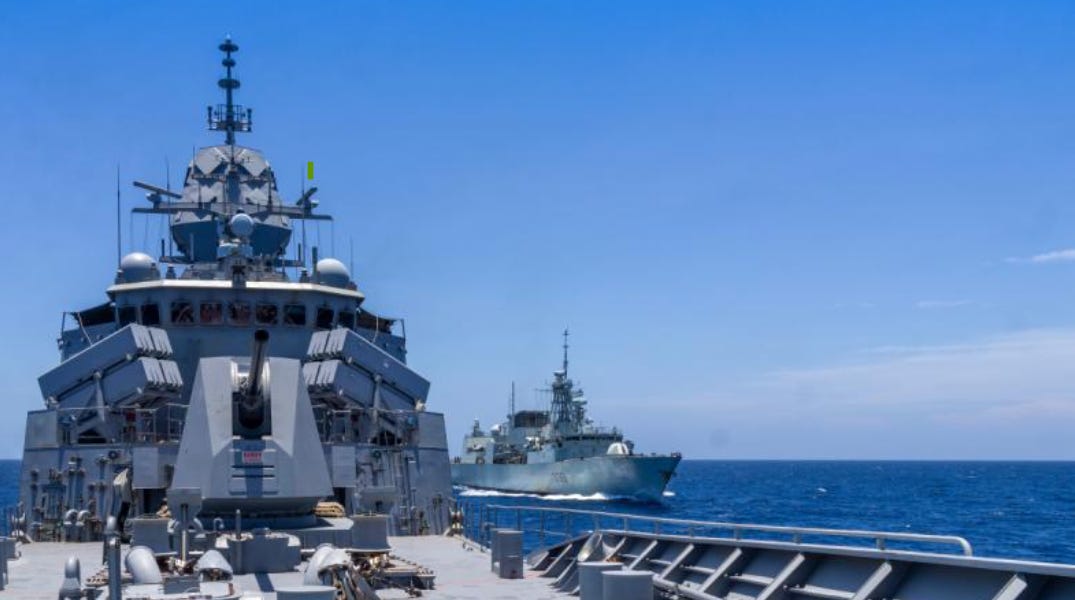
RAN and RCN combined live-fire in the South China Sea (reported 20 and 28 May). HMAS Toowoomba and HMCS Charlottetown operated as a combined unit for more than two weeks, including coordinated surface engagements using the five-inch gun, Phalanx CIWS and heavy machine guns. Primary-source Australian Defence reporting, and a direct Canada-Australia interoperability story.
AtkinsRéalis acquires Coras Solutions (7 May). The Montreal engineering and nuclear firm has agreed to acquire the 70-person Australian defence and national security consultancy (Canberra, Sydney, Adelaide), its second Australian acquisition in weeks, positioning the company at the advisory front end of Defence programmes.
Watch: Canada seems to be making aerospace inroads into the region. Backlash on AUKUS’s used boats. If Pillar 1 is struggling, will Pillar 2 amount to much, or will partners so focused on delivering a struggling nuclear programme leave room for allies to step in and help?
TAIWAN: Continuous Pressure as Canada Sails the Strait and an MP Visits
Freedom of navigation, and MP travel. HMCS Charlottetown conducted a solo Taiwan Strait transit (22-23 May), the first unaccompanied Canadian transit under the Carney government and only the second since the election. Beijing rebuked the passage as undermining sovereignty “under the pretext of freedom of navigation.” It followed Ambassador Wang Di’s warning that further transits would harm the new partnership, and preceded Wang Yi’s Ottawa visit by days. Defence Minister McGuinty holds that the strait is international waters. Conservative MP Michael Chong, sanctioned by Beijing since 2021, also visited Taiwan the same week, meeting President Lai and framing the trip as a matter of Canada deciding its own diplomacy.
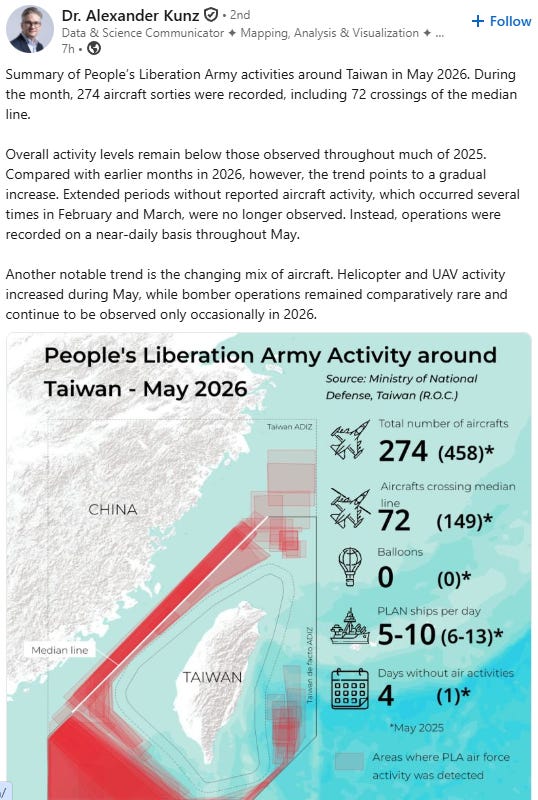
Intensive activity from the PLA. The pressure is not limited to the strait. The PLA’s Southern Theater Command said it drove off Dutch frigate HNLMS De Ruyter near the Paracels using warnings and electronic interference (27 May), a rare public PLA claim of EW employment against a European warship. Closer to the strait, the PLA’s 73rd Group Army in Fujian has re-equipped with the longer-range HQ-16F air defence system.
·
Credit Dr. Alexander Krunz, Source: Linkedin
OTHER REGIONAL DEVELOPMENTS
Regional: from hub-and-spoke to security web. Breaking Defense charts the shift from the old hub-and-spoke alliance model toward an allied “security web” of overlapping minilateral ties, a useful frame for several items in this edition.
India: long-range missile test, Strait of Malacca airstrip, ammunition exports. DRDO tested an Advanced Agni MIRV-capable missile from the Agni-5 family (8 May), releasing multiple payloads against separated impact points; the family’s range is widely estimated beyond 5,000 km. Groundwork has begun on a second Great Nicobar airfield at the mouth of the Malacca Strait, a roughly USD 1.6 billion dual-use project south of INS Baaz. A consignment of more than 60,000 155mm ammunition components also shipped from Chennai Port for export. Customer is undisclosed, but likely European. India agreed with Vietnam to expand defence sales.
Philippines: DND stakeholder engagement in Manila. The Stakeholder Engagement Team from ADM(Public Affairs), working with the Canadian Defence Attaché team in Manila, conducted the first Indo-Pacific visit under the renewed Stakeholder Familiarization Visits Program.
Malaysia: Norway’s NSM cancellation becomes a procurement crisis. Norway’s revocation of the export licence for the Naval Strike Missile has ended a 2018 contract worth roughly EUR 124-125 million on which Malaysia had reportedly paid about 95 per cent. Kuala Lumpur is claiming damages in excess of RM 1 billion and evaluating three to four replacement proposals, with Türkiye’s ATMACA reportedly the front-runner ahead of Exocet and Haeseong. The episode will not be lost on other regional buyers weighing Western systems: export licences are a risk.
Indonesia: Scorpene preproduction. PT PAL has entered the pre-production stage for the Scorpene Evolved, positioning Indonesia as the first ASEAN state to build its own submarines, with engineers embedded at Naval Group in Cherbourg for technology transfer. Jakarta has also confirmed Mogami frigate and submarine offers from Japan (see Japan above).
KEY UPCOMING EVENTS
Critical Minerals for Defence | 9-10 June | Toronto
Barrie Sandbox Centre, Defence and Dual Use 101 | 15 June | Barrie, ON
Team Canada Trade Mission to Japan | June | Tokyo
Naval Defense Philippines | 17-19 June | Manila
ADSE 2026 | 6-7 August | Abbotsford, BC
Canadian Aerospace Summit | 27-28 October | Ottawa
Did we miss something? Is there something that you want us to cover?