


Executive Summary
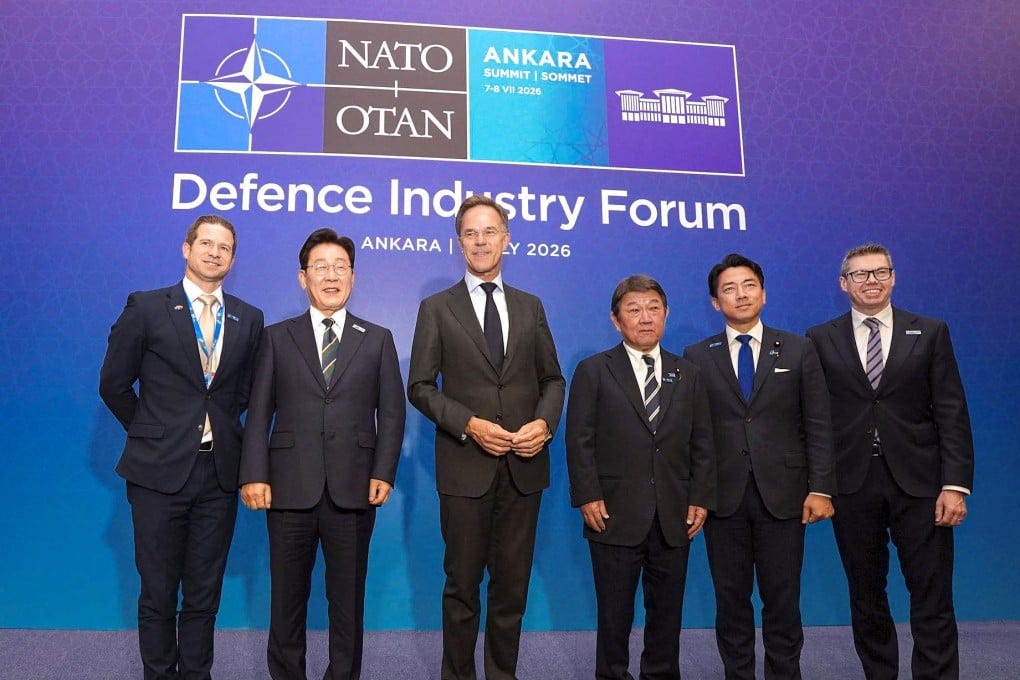
Ottawa selected Thyssenkrupp Marine Systems as preferred supplier on 6 July to enter negotiations for up to 12 Canadian Patrol Submarines, with contracting targeted no later than the end of 2027 and Hanwha Ocean available if those negotiations do not succeed. Five weeks later, Canada, Germany, Norway and TKMS held their first joint planning event in Kiel. At the Ankara NATO Summit, Canada and eight partner governments announced support for the Defence, Security and Resilience Bank, while eleven allies, including Canada, launched joint procurement negotiations with Saab for up to ten GlobalEye airborne early-warning aircraft based on Bombardier’s Global 6500. The four Indo-Pacific partners also met NATO Secretary General Mark Rutte on the margins of the summit, with discussions covering defence industry, cyber and technology.
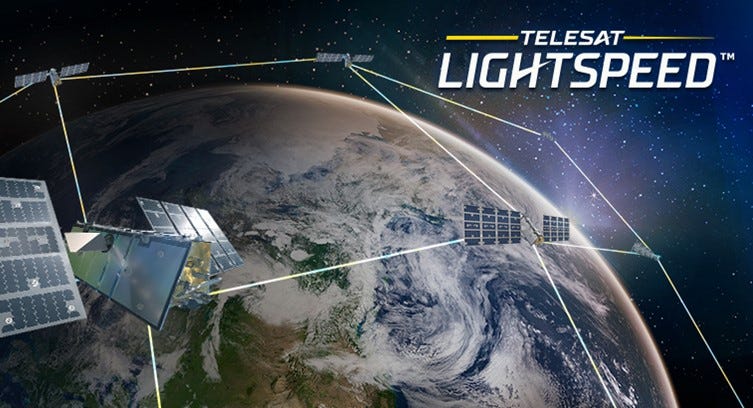
Telesat signed a $2.3-billion, 15-year Arctic military satellite-communications contract, rising to $2.7 billion with options. MDA added $474 million to its Lightspeed work, including 27 additional satellites, military Ka-band modifications across the fleet and long-lead items; Telesat’s funded constellation expands by 69 satellites to 225. Korean Air also formalized the acquisition of two Bombardier Global 6500 aircraft for South Korea’s stand-off electronic-warfare programme.
Canada and ASEAN adopted a 2026-2030 Plan of Action for their Strategic Partnership during meetings in Manila. The Philippine Senate subsequently voted 19-0 to concur in ratification of the Canada-Philippines Status of Visiting Forces Agreement; it will enter into force 30 days after the parties exchange diplomatic notes confirming completion of their domestic procedures. Japan and Canada held political-military and military-to-military dialogues in Ottawa on 31 July. In the wider region, China test-fired a dummy-warhead ballistic missile from a nuclear-powered submarine into the South Pacific, while Canadian military and coast guard assets monitored two Chinese research icebreakers operating outside Canada’s exclusive economic zone.
WHAT TO WATCH
Immediate (Next 30 Days)
Ulchi Freedom Shield (17-27 August): if the full operational capability assessment is completed and announced, the fall Security Consultative Meeting becomes a transfer-date meeting; silence means the timeline is slipping.
Defence Drone Initiative: the first qualification round closes 14 August; the pace of the awards that follow is the test of the Defence Investment Agency’s rolling model, and the signal for Canadian uncrewed-systems firms deciding whether to queue for round two.
Taiwan’s budgets: cabinet approval of the record 2027 budget lands 20 August; the harder question is whether the drone special budget clears its floor vote.
Medium-Term (2026)
CPSP negotiations: the Kiel planning event began structuring the trilateral program; watch the negotiating framework firm up against Ottawa’s end-2027 contracting target, and watch which Canadian suppliers surface in the TKMS teaming map.
DSRB membership: watch for the first Indo-Pacific member; Tokyo’s dialogue tempo makes Japan the natural candidate.
The Korea relationship: if the Defence Cooperation Agreement talks and information-sharing arrangements idle while Hanwha campaigns elsewhere, the fallback option loses practical value.
Strategic (2026+)
GCAP: if the entry-into-service pull-forward to about 2033 holds, Canada faces its combat-air bridging question sooner than planned; watch whether observership opens partnering opportunities for Canadian firms.
Jangbogo-N: the special act targets enactment by end-2026; Korea’s nuclear-powered submarine program is becoming institutional fact, shaping the 2030s underwater balance Canada’s boats will enter.
CANADA: CPSP Negotiations Open, Record Arctic Satcom Contract, RIMPAC Command Roles, First GCAP Observer
Procurement in negotiation: Ottawa selected TKMS on 6 July to enter negotiations for up to 12 submarines, with contracting targeted by the end of 2027 and Hanwha Ocean the alternative if talks fail; five weeks later the first joint planning event in Kiel opened the trilateral program structure with Germany and Norway. The Defence Investment Agency signed its record Arctic satcom contract with Telesat, with service from early 2028 and the satellite build in Montreal. The DSRB’s nine founders so far include no Indo-Pacific member. For Canadian suppliers, the negotiation phase is when the CPSP industrial map gets drawn; positioning with TKMS and its partners starts now.
Command roles across the theatre: More than 800 Canadians returned from RIMPAC having commanded a carrier-defence task group and the multinational air component, with the first live torpedo firings of the Underwater Warfare Suite Upgrade and HMCS Corner Brook’s torpedo shot in the sinking exercise, the first Canadian submarine at the exercise in over a decade. Canadian personnel embedded in Exercise Pitch Black 2026, held senior command roles in Pacific Partnership, trained at Khaan Quest in Mongolia, and join UN Command nations at Ulchi Freedom Shield (17-27 August).
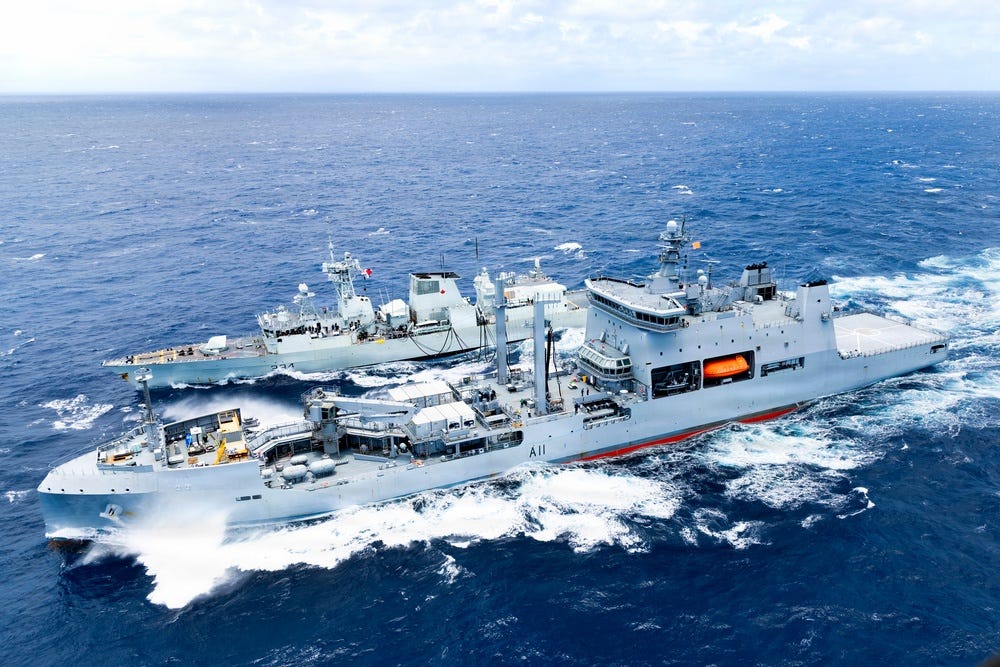
The Royal Canadian Navy Halifax-class frigate HMCS Regina, the Royal New Zealand Navy polar-class sustainment vessel HMNZS Aotearoa during the sea phase of Exercise Rim of the Pacific 2026 in the Pacific Ocean, July 12, 2026 Credit DVIDS First GCAP observer: Canada became the Global Combat Air Programme’s first observer nation on 21 July, gaining enhanced insight into programme governance, capabilities, the industrial framework, security requirements and partnering opportunities, with no financial commitment at this stage; observership does not determine the separate near-term fighter review. Leonardo is pushing to pull entry into service forward to about 2033. The partnering-opportunities language is the opening for Canadian aerospace, engineering and cyber-assurance firms to map their entry points now.
Watch: Does observership open partnering opportunities for Canadian firms? Who joins the DSRB next?
UNITED STATES: Pax Silica Moves From Minerals to AI
Contributed by Ryan Caldwell of De Stijl Consulting.
The U.S. made a bold statement by announcing a major AI technology investment in the Philippines, which the local government projects could attract tens of billions of dollars in further investments, through the Pax Silica initiative.
Pax Silica, which is a U.S. State Department initiative first stood up in December 2025, has previously focused on critical minerals investments, but the program appears to be moving much of its $250 million budget to AI investments, including a recently announced pilot project for AI-enabled expedited customs and compliance checks in Panama.
Canada, which is not a member of the Pax Silica signatory group, has to date been on the outside looking in. How this shakes out in the future, along with how Pax Silica would play alongside the much larger America First Opportunity Fund — if the A1OF is funded — remains an open question.
The U.S. knows that it needs to continue partnering with Canada on critical minerals, which is why those items were carved out of the recently announced 50% tariffs. And Pax Silica and A1OF are projected to spend hundreds of millions of dollars to bring miners and processors of critical minerals into the U.S. orbit.
Canadian and other firms should look at developing both U.S. and third country partners for tech and critical mineral investments in areas that Pax Silica is focused on, namely the Indo-Pacific and Central Africa.
For further information and assessments of potential projects, contact PerceptX or De Stijl Consulting.
JAPAN: Dialogues in Ottawa, A White Paper as Mobilisation Plan, Record Order Books
The Canada channel, announced from Tokyo: Ottawa hosted the 14th Japan-Canada Political-Military Dialogue and the 15th Military-to-Military Dialogue on 31 July, with both sides agreeing to accelerate the security elements of the March Comprehensive Strategic Roadmap. Tokyo announced both meetings; I found no corresponding Canadian public release as of 13 August. On the industry track, Canada launched a dual-use and defence technology stream under its Canadian Technology Accelerator programme, selecting approximately 8-10 Canadian companies for a 28 September-2 October mission involving SEECAT and meetings with Japanese investors, customers and industrial partners: the most concrete Canada-Japan market-entry channel this cycle.
The white paper as mobilisation plan: Cabinet approved Defense of Japan 2026 on 4 August, naming China the greatest strategic challenge and warning it can project power beyond the First Island Chain. The paper sets out a littoral defence architecture built on uncrewed air, surface and underwater systems (SHIELD, targeted for fiscal 2027), munitions stockpiling and industrial mobilisation with deeper startup engagement. For Canadian firms the demand signals are specific: uncrewed systems, munitions, sensors and dual-use partnerships are where Tokyo says the money goes.
Order books and the frigate line: Mitsubishi Heavy posted a record first quarter and raised its defence order target; Oki Electric booked its first overseas defence sale, towed sonar for Australia’s Mogami-based frigates; and the second Japan-Australia-New Zealand defence ministers meeting met as Wellington weighs the Upgraded Mogami against the Type 31. Nikkei reported that Japan’s Financial Services Agency had begun reviewing defence-sector financing by major banks and insurers, a question Canadian banks are starting to answer too.
Watch: Does the DSRB draw Tokyo’s interest? Is the financing review part of a move to join DSRB? Which Canadian firms follow MDA?
SOUTH KOREA: Missiles Before Ulchi, Life After the Submarine Decision, KF-21 Development Complete
Missiles before the exercise: North Korea fired ballistic missiles on 6 August and 12 August, its first ballistic launches since June, ahead of Ulchi Freedom Shield (17-27 August: about 18,000 Korean troops, personnel from 12 UN Command states, Canada among them). Foreign ministers Cho Hyun and Anita Anand met in Manila on 22 July, the first senior contact since the submarine decision.
Life after the decision: Hanwha reportedly put its Ontario armoured-vehicle joint-venture plans on hold, while Korean firms reviewed Canada-related memorandums following the CPSP decision. Separately, Hanwha continued campaigns in Saudi Arabia, Thailand and Greece. Hanwha remains eligible to be designated preferred supplier if negotiations with TKMS do not succeed. For Ottawa, the policy question is which pieces of the Team Korea web (steel, training, batteries) are worth pursuing on their own merits.
The next programs: Seoul institutionalized the Jangbogo-N nuclear-powered submarine program with a draft special act and new program offices; DAPA concluded KF-21 development after ten years and seven months, with first production jets due from September; and Hanwha Defense USA made a non-binding offer of 1.05 to 1.2 billion US dollars for Austal USA, excluding Austal’s Australian sovereign shipbuilding business.
Watch: How does Ottawa keep the Defence Cooperation Agreement and information-sharing arrangements warm while Hanwha looks elsewhere?
AUSTRALIA: A-OTHR Work Begins in Ontario, The Acquisition Rebuild, AUKUS Firms Up
A-OTHR work begins: Work began 1 July (pre-window context) under the Canada-Australia Arctic over-the-horizon radar partnership: BAE Systems Australia transfers technology so Canada can build its own sites, with transmitter facilities planned for Kawartha Lakes, receivers for Clearview Township, Ontario, first site work expected in winter 2026-27 and initial operational capability targeted for December 2029. For the Ontario communities and suppliers involved, the work is now real; for Ottawa, it is the first big test of buying a partner’s system while keeping the build at home.
The acquisition rebuild, a comparator for Ottawa: The 2026 Defence Industry Development Strategy took effect 1 July, merging three groups into a Defence Delivery Group under a National Armaments Director, the biggest acquisition shake-up in fifty years and the closest allied analogue to Canada’s Defence Investment Agency. Enduring US submarine access at HMAS Stirling was confirmed, a $76.6-billion US block buy eased the Virginia bottleneck, and Lockheed Martin Australia stood up sovereign Virginia-class combat-system integration, the same technology-transfer machinery Canada now has to negotiate with TKMS.
Pitch Black and the export line: Exercise Pitch Black 2026 concluded 7 August with about 100 aircraft and more than 2,500 personnel from 21 nations, RCAF personnel embedded. Boeing and Rheinmetall are pitching the Australian-built MQ-28 Ghost Bat to Germany (no contract yet), a route Canadian uncrewed-systems firms eyeing the same European demand should watch.
Watch: Does the Delivery Group move contracts faster than the machinery it replaced? Does an Australian-developed system land its first big European sale?
OTHER REGIONAL DEVELOPMENTS
ASEAN-Canada: At the 22-23 July ASEAN meetings in Manila, Canada and ASEAN adopted a 2026-2030 Plan of Action for their Strategic Partnership. Canada also extended its ASEAN Regional Forum cyber co-chairship with India and Indonesia and will host the next ARF heads-of-defence-universities meeting in Victoria in October, keeping Ottawa at the region’s security table and opening an institutional lane for Canadian dual-use firms.
Philippines: The Senate voted 19-0 to concur in ratification of the Canada-Philippines Status of Visiting Forces Agreement. It is not yet in force; entry occurs 30 days after the parties exchange diplomatic notes confirming completion of their domestic procedures, following the elevation to a Strategic Partnership during President Marcos’s Vancouver visit (2 July, pre-window context). Once in force, expect a standing Canadian training presence and the sustainment contracting that follows it.
Canadian Arctic monitoring: Under Operation Latitude, Canada deployed HMCS Ottawa, HMCS Max Bernays, HMCS Robert Hampton Gray, a CP-140 Aurora, special-operations personnel and CCGS Des Groseilliers to monitor activity in the Arctic and Bering region, including the two Chinese research icebreakers.
Taiwan: Defence spending heads above a record NT$1.1 trillion for 2027 (cabinet approval expected 20 August); the NT$210-billion drone special budget remains stalled; Han Kuang 42 rehearsed blockade survival with Taiwan’s first deliberate mobile-network slowdown.
Singapore: Signed the Industrial Base Resiliency Arrangement with Australia, covering cross-sustainment, priority deliveries and supply-chain risk sharing, a template Ottawa could seek with either partner.
Malaysia: Malaysia selected an MBDA surface-to-air missile system for its littoral combat ships. Separately, the ships’ anti-ship missile fit remains unresolved after Norway revoked the Naval Strike Missile export licence. A Canada-Malaysia defence pact is taking shape, the channel that could potentially put Canadian suppliers in front of these programs.
India: High Commissioner Patnaik and Minister McGuinty mapped maritime and training cooperation in Ottawa; the third trade round concluded; Anand and Jaishankar met in Manila.
New Zealand: Wellington opened its purchase of long-range one-way strike drones and market research into uncrewed maritime surveillance aircraft, in the NZ$100-300-million band, a procurement scale within reach of Canadian uncrewed-systems firms.
UPCOMING EVENTS
Seoul Defense Dialogue 2026 | 7-9 September | Seoul
Canadian Technology Accelerator co-innovation mission to Japan | 28 September-2 October | Japan
DEFSEC Atlantic 2026 | 6-8 October | Halifax
Land Forces 2026 | 6-8 October | Perth
Team Canada Trade Mission to India | 12-17 October | India
Best Defence Conference 2026 | 20-21 October | London, Ontario
Deep Blue Forum 2026 | 27 October | Ottawa
Canadian Aerospace Summit 2026 | 27-28 October | Ottawa
Pier71 Smart Port Challenge Grand Finale | 11 November | Singapore
MilCIS 2026 | 17-19 November | Canberra
Halifax International Security Forum 2026 | 20-22 November | Halifax
K-DEX 2026 (integrating KADEX and DX Korea) | 8-11 December | KINTEX, Goyang
Vietnam International Defence Expo 2026 | 10-13 December | Hanoi
Aero India 2027 | 8-12 February 2027 | Bengaluru
Avalon Australian International Airshow 2027 | 23-28 February 2027 | Geelong
Canada-in-Asia Conference 2027 | 3-4 March 2027 | Singapore
Ottawa Conference on Security and Defence 2027 | 10-11 March 2027 | Ottawa
CANSEC 2027 | 2-3 June 2027 | Ottawa